Explore the Universe with Hertford Astronomy Group
Join our monthly meetings and astrophotography sessions for all ages at the University of Hertfordshire.


Next Meeting:
Wednesday February 11th at 8:00pm
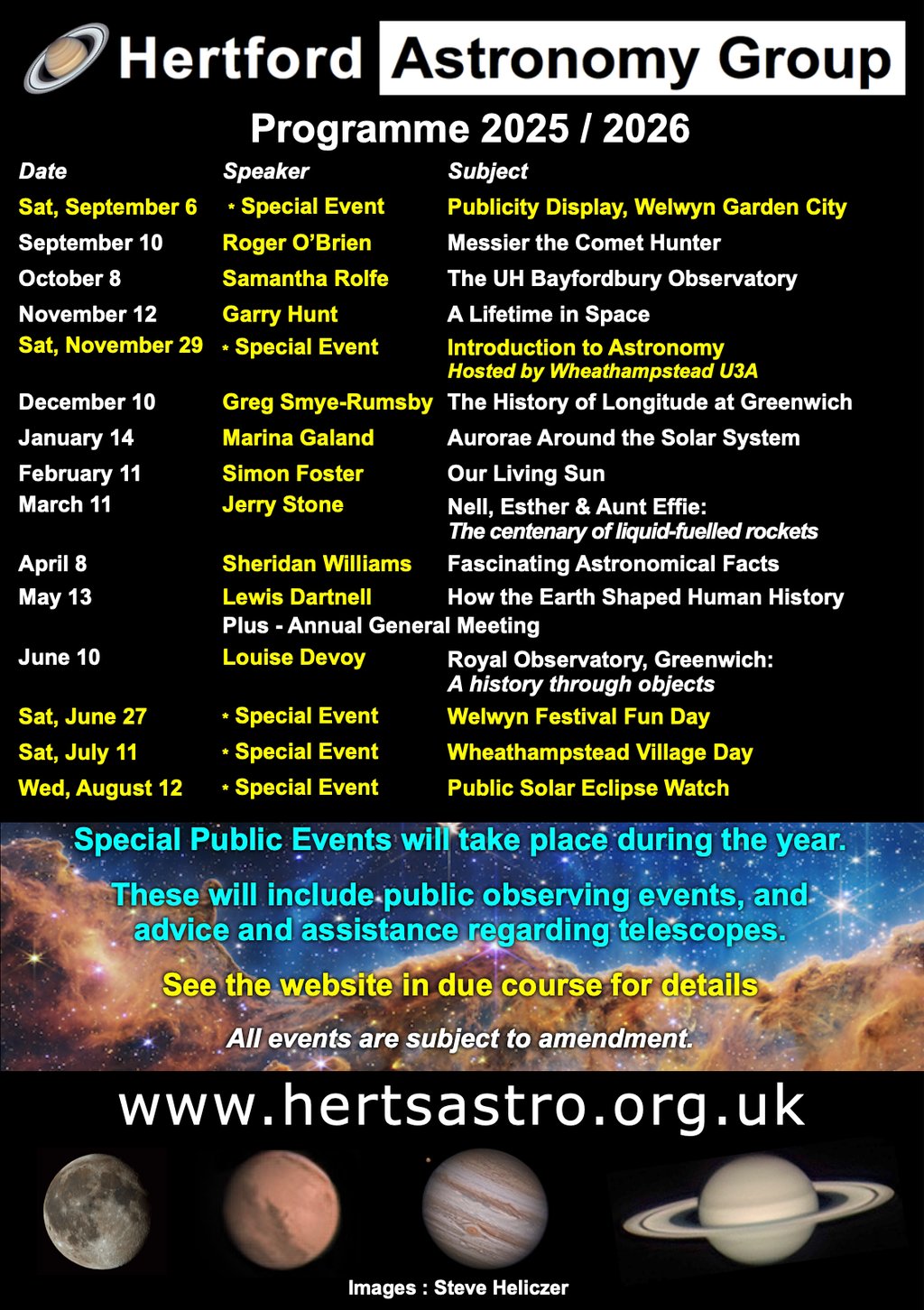
Our Living Sun
Simon Foster
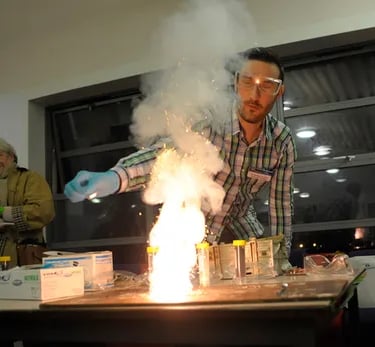
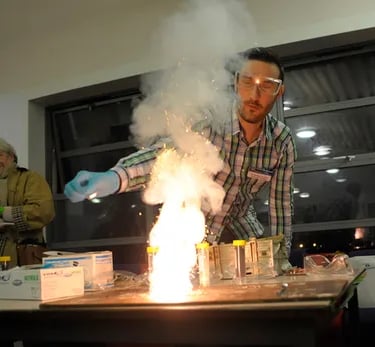
People are often surprised when our Sun is described as 'living', but in many ways, it can be seen through the lens of a human's lifecycle, being born, going through various stages of life and then dying. Humans have studied the Sun in various forms for thousands of years, but consistent and reliable data has only been available for the last 50 years, meaning it is very hard to make predictions of its behaviour and its impact to life on Earth.
This was brought into sharp focus with the solar storms of May 2024, bringing to public attention the concept of 'space weather', with the UK experiencing a once in a lifetime display of the Northern lights. To most people this was simply a beautiful natural phenomenon, but the potential impact to national and global infrastructure was devastating, with worst case scenarios predicting trillions of pounds of damage.
In this talk, we will have brief look at the history of the Sun, it's current status and what this all means for us.
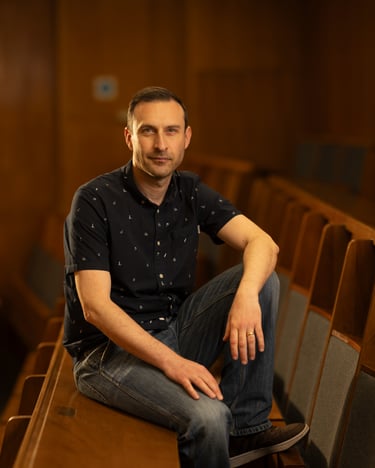
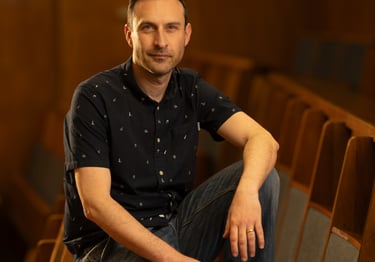
Dr Simon Foster is a space scientist at Imperial College London with over two decades of experience in solar‑terrestrial physics and STEM education. His research on sunspots and solar variability has informed understanding of how the Sun influences Earth’s climate, including contributions to the IPCC 4th Assessment Report.
A leading science communicator, he has delivered school talks, festival events, TV and radio appearances, and educational videos, alongside directing outreach for Imperial’s Faculty of Natural Sciences and Space Lab. Inspired in childhood by astronomy and Helen Sharman’s mission, he remains passionate about new space exploration and the rise of commercial spaceflight
Stephen Hawking
Remember to look up at the stars and not down at your feet.
*****
Meeting Location
Our meetings are held at the
University of Hertfordshire
Lindop Building
College Lane
Hatfield
AL10 9AB
(What 3 words: stars.stones.energetic) and simultaneously on Zoom.
There is plenty of parking space around the venue which is free after 19:00
What to look forward to?
We always like to keep an exciting programme of events throughout the year.
Wednesday, March11th
The University of Hertfordshire presents ....
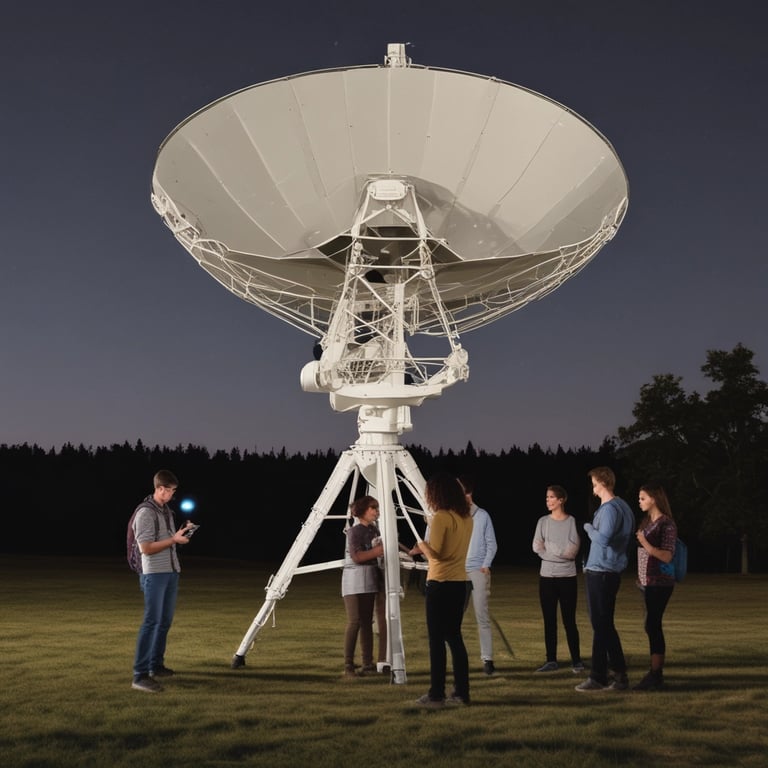
We have three wonderful student volunteers from the University of Hertfordshire visiting us to give us talks about their subjects of interest.
Camilla Di Giusto
The most powerful Engines of the Universe and what they have to do with the formation of stars
At the centre of most large galaxies in the universe live mysterious engines. They are millions, if not billions, of times more massive than our Sun and feed on anything that comes too close to them, including light. Who are we talking about? Supermassive black holes, of course. Interestingly, as they eat up material, they also produce and eject a lot of energy into their surroundings. Come and find out how this enormous energy input from black holes changes the formation of stars and how we can study this.
Angrilla Muglia
What’s the Matter?
This talk is about the origin of the elements, the story of how the universe became enriched with the building blocks of matter we see today. I will explain how stars, through their lives and explosions, produced the chemical ingredients that later became part of planets and galaxies. To follow this story we use both telescope observations and computer simulations, which allow us to connect the first generations of stars to the growth of cosmic structures. I will also talk about our very own Milky Way, and the peculiar chemical laboratories that are smaller (dwarf) galaxies, showing how they help us understand the diversity of environments where elements are formed. Spoiler alert: we are made of stardust!
Anushka Shinde
Exocomets of Beta Pictoris
Abstract: Most people may have heard of exoplanets, but what about exocomets? My talk is focused on the Beta Pictoris system, which was the first system beyond our own Solar System where comets were detected. With its edge on disk and at least 2 planets confirmed, this system has caught the interest of astronomers to study the early solar system formation. My Master’s project was focusing on the use of the TESS Sector 87 data to remove the delta-scuti pulsations of the host star, Beta Pictoris, to extract possible signals of exocomets.
******************
******************
******************
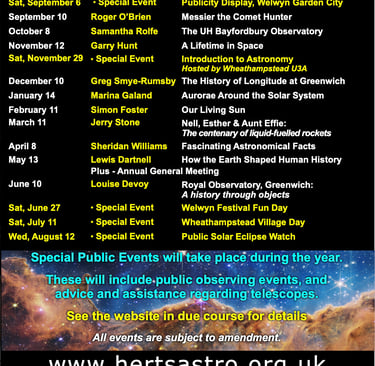
More to look forward to ....
We offer telescope advice, access to observatory open evenings, and live Zoom meetings for those unable to attend. Join us online or in person!
Astronomy Club Services
Join our astronomy club for meetings, astrophotography, and telescope advice at the University of Hertfordshire.
...or just come along to a meeting as a visitor


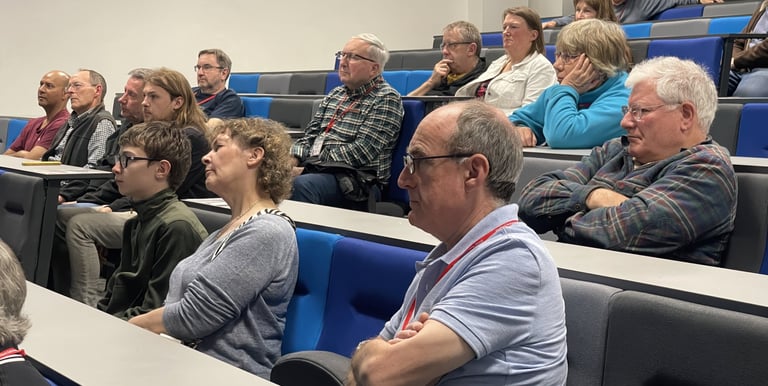
Observatory Access
Enjoy open evenings at Bayfordbury Observatory and attend lectures from the Institute of Physics.
Live Meetings
Participate in our live meetings via Zoom, with recordings available on our YouTube channel.


Observation Meetings
Bring your telescopes along and carry out visual observations at our Bramfield site.
Contact Hertford Astronomy Group
Reach out for astronomy advice or meeting information today!


Explore
Join our astronomy club for monthly meetings.
Connect
Learn
© 2026. All rights reserved.